Introduction
Grover’s algorithm is an algorithm to perform search on an unordered list. Ordered lists can be searched efficiently using binary search, but classically an unordered list requires (O(N)) checks. Grover’s algorithm reduces this to (O(\sqrt{N})) operations—often not enough for quantum advantage, but crucial as an amplitude-amplification subroutine and for its educational simplicity.
Problem statement: Given an unordered list of values, return the index (position) of the element that satisfies a criterion (the function to test this criterion is called an oracle).
Algorithm Outline: Prepare a superposition over every index and repeatedly apply an operation that amplifies the amplitude of the marked index until it dominates the output, in (O(\sqrt{N})) applications.
Need for an efficient and useful oracle: The oracle identifies the state of interest. Many toy derivations assume knowledge of the result, but the algorithm also works with a realistic oracle. See oracle for current proposals.
Algorithm Outline
See the IBM tutorial for complementary details; this guide focuses on the mathematical derivation of the computational complexity.
We start with the uniform superposition
$$ |s\rangle = \frac{1}{\sqrt{N}}\sum_{x=0}^{N-1}|x\rangle. $$
Rewrite it using the target state (|\omega\rangle) and its orthogonal complement
$$ |\omega_\perp\rangle = \frac{1}{\sqrt{N-1}}\sum_{x\neq \omega}|x\rangle. $$
Express the amplitudes trigonometrically for later convenience:
$$ |s\rangle = \frac{1}{\sqrt{N}}|\omega\rangle + \frac{\sqrt{N-1}}{\sqrt{N}}|\omega_\perp\rangle = \sin(\theta)|\omega\rangle + \cos(\theta)|\omega_\perp\rangle. $$
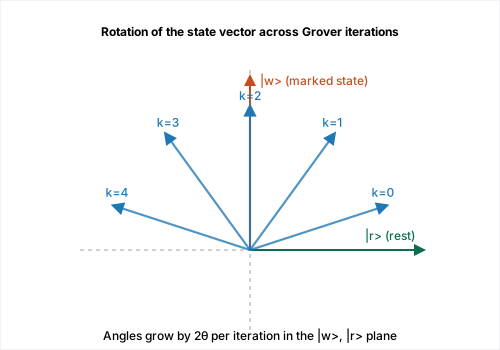
The Grover operator (G) is two consecutive Householder reflections: the oracle (U_\omega) and the diffusion (inversion-about-the-mean) operator (U_s):
$$ U_{\omega}=I-2|\omega\rangle\langle\omega|,\qquad U_{s}= -(I - 2|s\rangle\langle s|),\qquad G = U_s,U_\omega. $$
Each application of (G) amplifies the amplitude of (|\omega\rangle) up to an optimal number of iterations derived below.
Matrix representation of Grover operator
Using Sympy in the basis ({|\omega\rangle, |\omega_\perp\rangle}):
from sympy import Matrix, symbols, sin, cos, eye

θ = symbols('theta', real=True, positive=True)
ω = Matrix([1, 0])
s = Matrix([sin(θ), cos(θ)])

Uω = eye(2) - 2*(ω * ω.T)
Us = 2*(s * s.T) - eye(2)
The diffusion operator simplifies to
$$ U_s = \begin{bmatrix} -\cos(2\theta) & \sin(2\theta)\ \sin(2\theta) & \cos(2\theta) \end{bmatrix}, $$
and the Grover operator
$$ G = \begin{bmatrix} \cos(2\theta) & \sin(2\theta)\ -\sin(2\theta) & \cos(2\theta) \end{bmatrix}. $$
Amplitude of our target state after one iteration of the Grover operator
The amplitude of (|\omega\rangle) after one Grover iteration starting from (|s\rangle) is
$$ \langle \omega | G | s \rangle = \sin(3\theta), $$
which is larger than the starting amplitude for sufficiently large (N) (small (\theta)).
Diagonalization of the Grover operator
Diagonalizing (G) makes repeated applications simple. Its eigenvalues in the reordered basis are
$$ \Lambda = \operatorname{diag}(e^{2 i \theta},, e^{-2 i \theta}), $$
with change-of-basis matrix
$$ C_m = \begin{bmatrix} -i & i\ 1 & 1 \end{bmatrix}. $$
Raising (G) to the (r)th power amounts to powering the diagonal matrix:
$$ G^r = C_m,\Lambda^r,C_m^{-1} = C_m \begin{bmatrix} e^{2 i r \theta} & 0\ 0 & e^{-2 i r \theta} \end{bmatrix} C_m^{-1}. $$
Complexity of the algorithm and optimal number of iterations
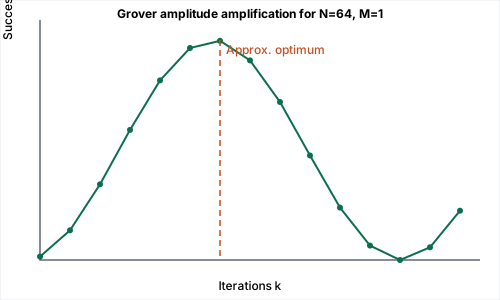
Starting from (|s\rangle), after (r) Grover iterations the success probability is
$$ p = |\langle \omega | G^r | s \rangle|^2 = \sin^2\bigl(\theta(2r + 1)\bigr). $$
The optimum occurs when (\theta(2r + 1) \approx \pi/2), giving
$$ r \approx \frac{\pi}{4}\sqrt{N} + O(1; N \to \infty), $$
so the algorithm scales as (O(\sqrt{N})). Overshooting the optimum causes the probability to decrease as the rotation continues.
Notes on the oracle
Many didactic treatments use an oracle that assumes the answer. Practical oracles can be built as quantum lookup tables (T(i)=x), but constructing them efficiently is challenging. Recent proposals achieve (O(\sqrt{N})) scaling for lookup; see qLUT and QRAM.
Sources
- https://arxiv.org/pdf/quant-ph/9605043 — original paper
- https://arxiv.org/pdf/quant-ph/9605034 — proves it cannot be done faster than (O(\sqrt{N}))
- https://arxiv.org/pdf/quant-ph/9711070 — proves it cannot be parallelised faster
- https://github.com/Qiskit/textbook/blob/main/notebooks/ch-algorithms/grover.ipynb — comprehensive notebook using Qiskit
- https://en.wikipedia.org/wiki/Amplitude_amplification — reference for amplitude amplification
- https://en.wikipedia.org/wiki/Grover%27s_algorithm — background material
- https://www.cs.cmu.edu/~odonnell/quantum15/lecture04.pdf — detailed lecture notes
- https://arxiv.org/pdf/1812.00954 — first (O(\sqrt{N})) oracle
- https://arxiv.org/abs/2408.16794 — state-of-the-art oracle